I read The New York Times, The Morning, almost every morning. On March 30, 2026, the main content of the newsletter was readers’ questions. It begins as follows:
Your questions
There is a lot going on in the world right now, much of it confusing, some of it contradictory, all of it important. War rages, economies rattle, trends emerge. Why? And what’s with all the self-checkout lines at Target and CVS?
We brought your questions to expert Times reporters.
What are Times reporters expert in? Journalism? Because covering a beat doesn’t make one an expert. It means you have enough basic knowledge of a topic that you can write for the average Times reader. That’s a bar low enough to trip over. How do I know that? Just look at the questions:
- If so little of our oil in America comes from the Middle East, why does this war have such a strong influence over gas prices and the stock market?
- How likely is it that Iran will retaliate for the war with an attack on American soil? As someone who remembers 9/11 vividly and now lives 40 miles from New York City, that’s my main concern for my family.
- My 401(k) has suffered since the war with Iran started. What generally happens to investments during a time of war?
- I’m anxious about upcoming food shortages across the world due to the war. Am I being a doomsayer or are these fears founded?
- I’d like to understand whether progress is being made toward treating addiction with GLP-1 medications.
- What drives retailers like Target or CVS to favor self-checkout over staffed lanes (which are often not even staffed), given that it seems to worsen the customer experience? I now shop almost exclusively on Amazon to avoid this problem.
- Historically, how have presidents benefited financially from business ties while in office? The Trumps seem to be making money hand over fist. Is this fairly new? Are there no laws against it?
How did the Times experts answer? Mostly a mix of platitudes and half-truths. They explained the basics, such as the oil market is global. They called another 9/11 “unlikely” — but is that less than 50%, or 1%, and over what time scale? They suggested staying the course on 401(k) investments, in the face of an almost certain recession. Global food shortage “will probably be a slight increase in grocery bills” for American families. They stated that we don’t know if GLP-1 treats addiction, even though there is a study of 600,000 that suggests it does. Companies offering self-checkout would say that they offer all sorts of checkout options — cashier service, self-checkout and in-person pickup for online orders. Notice how the Times reporter presents checkout options, where the company outsources work to their customer, as a feature. And the last, my personal favorite, “In short, Trump’s profiting in office, while not clearly illegal, is unprecedented.” Expert reporters managed to say something true two times out of seven, if we are being generous, which two is left as an exercise for the reader.
That’s the lead story. Seven questions, presumably selected from thousands. Answered by “experts” that basically amount to, “Don’t worry, be happy.”
Now, let’s get to the news that’s going to help us make sense of a confusing world, under the heading The Latest News:
- War in Iran: One untested missile killed Iranian civilians. Asian countries are burning more coal. Then this:
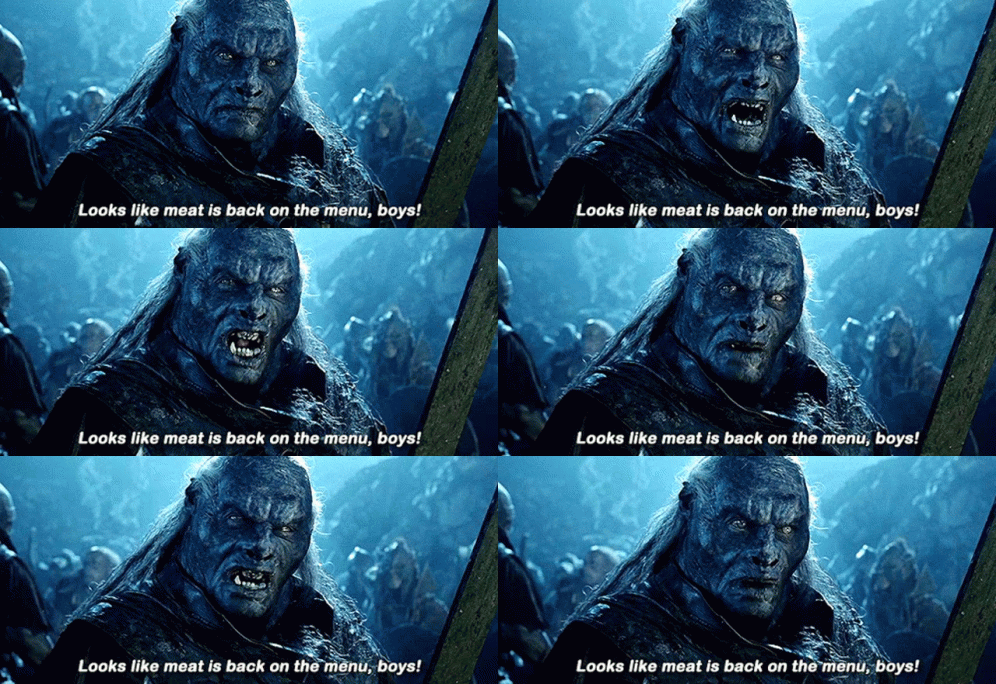
How is the war rippling across the world? Butter chicken has disappeared from some Indian menus. South Koreans were urged to take shorter showers. Party balloons may be harder to find.
- Politics: Trumps Ballroom. More people are dying in ICE custody. TSA officers will get paid, but ICE will still be in airports.
- Around the World: Rusty cyclones in Australia. Cuba receives oil from a Russian tanker. Israel stops Roman Catholic priests from doing mass for Holy Week, you have to go into the article to know why: it’s for their safety. South Korea has a lot of squatters because of rising housing costs.
- Other Big Stories: The Times recast Cesar Chavez as a complicated villain, a several decade old story told in drips over several weeks. A jury found Meta and YouTube guilty for making addictive products.
Then, we move on to opinions, where Craig Newmark, founder of Craig’s List, former billionaire, thinks billionaires should give away their money. To who? Who is this article for?
Then:
Rasputin. Roy Cohn. Jeffrey Epstein. Every era has had a “dark connector” who helps elites get what they secretly want, Jacob Weisberg writes.
Don’t worry everyone. This is just a historical pattern. No need to concern yourself about Epstein, the fact that it was an intelligence operation or that there are undoubtably new Epsteins using his playbook operating even now.
And we could go on. But that’s not the point. The real problem isn’t any single article or weak answer — it’s the structural mission of The New York Times itself. It is more than just the problem of prestige journalism. The newsletter is offering up pablum to subscribers. The question is: why?
The answer is this newsletter, and the broader context of The New York Times, is to make their readers feel safe. In ancient Rome, food and spectacle calmed the masses. The Times performs the inverse — not feeding the hungry but soothing the sated. The goal isn’t distraction through excess, but reassurance through gentle explanation. The result is journalism as comfort food, keeping the comfortable from arriving at uncomfortable conclusions.
Job one is to keep the subscriptions coming in. Normally, we think the people paying are the customers. But when Times experts reassure readers that grocery prices will rise only slightly, their investments are safe, and five minutes of unpaid cashier cosplay is a “feature,” whose interests does that serve?
How is war in Iran affecting the world? Less butter chicken. Fewer party balloons. Don’t worry; there’s other meat on the menu.